Showing posts with label Kanchenjunga Trek. Show all posts

Saturday, 15 November 2014

Kanchenjunga Trek - Bridges and Waterfalls

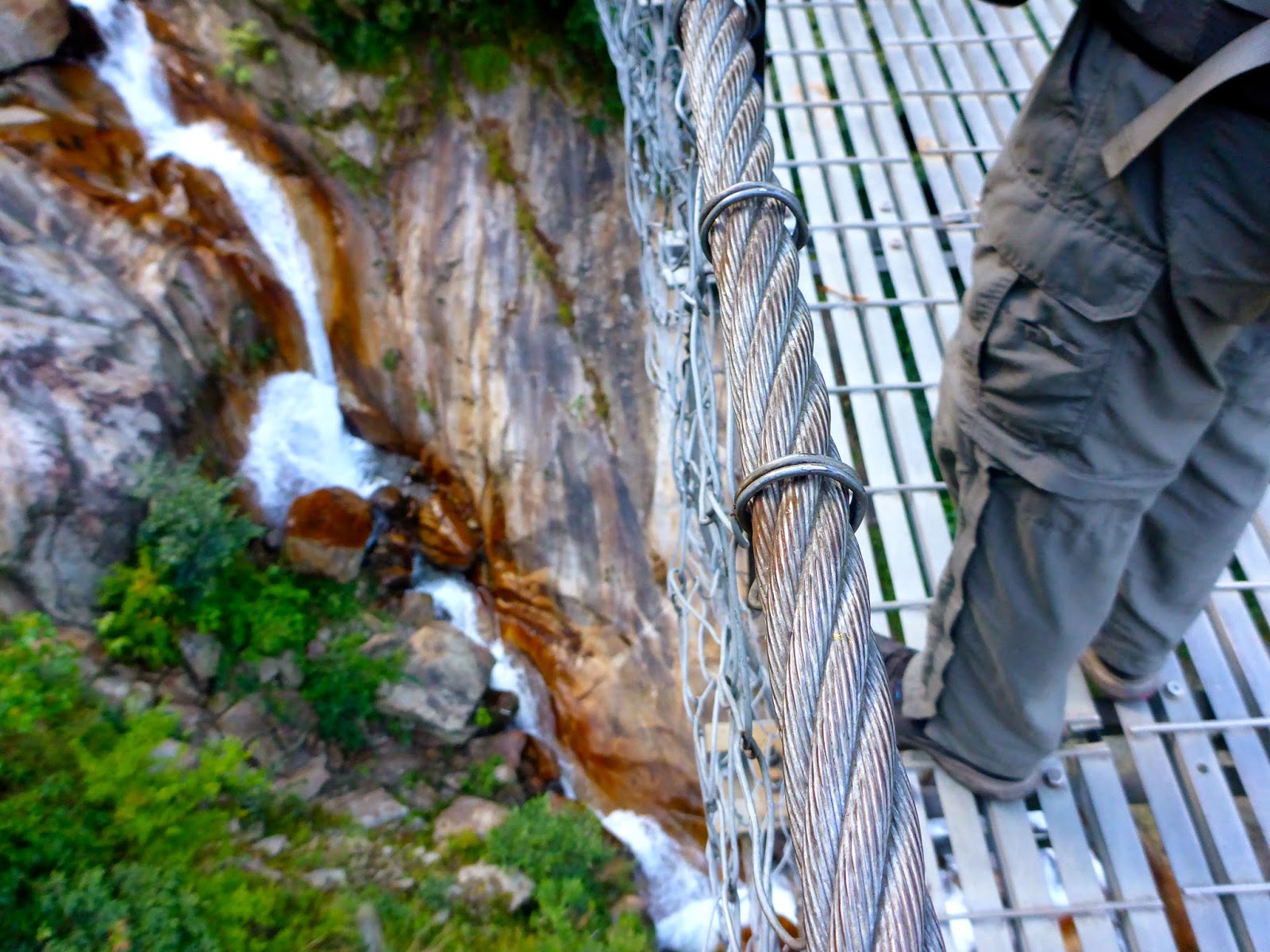
High cliffs with massive amounts of water flowing down them. River crossings in various states of repair from brand new to . . . should I really trust this?

The sheer number of waterfalls and bridges was another very unique aspect of our Kanchenjunga trek. Ghunsa was the only village on the trek that had hydroelectricity but Raj talked a bit about how it is increasing in Nepal (a Google search shows many articles about the vast potential for hydro power) and the sheer number of rivers and speed of the rivers and tributaries we saw certainly supports this.

There were many of these "swing bridges" which were often very long. They felt quite stable when you were the only one on it but when several people were moving across, it bounced and it was a bit disconcerting to not know exactly when your feet were going to make contact with the surface as you put your foot down. I was quite thankful for lots of experience with height and exposure!
Raj and Andrew


There were also several bridges in the process of being built. Scaffolding is just a bit different than what we would see at home! 


And there were many other types of bridges as required and various states of repair!


Kumar on the swing bridge with open sides


I know Andrew will have much better waterfall photos than these but until he gets through his bazillion trekking photos . . .


See my other Kanchenjunga Trek posts.

Friday, 14 November 2014

Kanchenjunga Trek - Our Team and Other Memorable People

This was my fourth time to Nepal. Andrew’s fifth. Plus a couple trips to other Himalayan countries. We thought we knew what to expect regarding guides and porters. But Himal, Raj, Pasang and Kumar from Visit Himalaya Treks far exceeded our expectations!
Our Team - me, Raj, Kumar, Andrew, Pasang
Andrew initially contacted Visit Himalaya based on a recommendation from the blog of an Australian couple that had used this company several times. He also contacted several other companies but Himal, the owner of Visit Himalaya, was the one who responded promptly and readily agreed to provide a mostly lodge-based trek with minimal support (as opposed to camping style with a large entourage of support staff).

Himal met us at the Kathmandu airport and his distinctive blue sign stood out from all the white ones. Over the few days we were in Kathmandu we met with Himal a couple more times to finalize the trek and, since we were immediately heading to India afterwards, he took us out for a “farewell” supper to a very unique Nepali restaurant with music and dancing demonstrations from various regions of Nepal.

We also met our guide, Raj, who accompanied us on the flight and drive to Fikkal where we met up with porters Pasang and Kumar who had taken the bus there with the gear.

Raj is a very charismatic and personable 25-year-old. He started trekking work as a porter, becoming an assistant guide to Himal and then moving up to guide. As a porter he had higher aspirations and always took the opportunity to talk to clients to improve his English. In addition to guiding and working in the office for Himal, he is taking various classes that interest him (e.g. computer-related such as web design, first aid, media reporting for trekking guides).
Raj
If anything, Raj was a little too good at looking after us. Constantly reminding us to be careful in slippery areas, going first across streams and helping us across, etc. But we managed to subtly let him know some of our experience, jokingly reminded him to be careful, helped him across streams and basically teased him mercilessly, all of which he took in good stride and laughed with us about.

We were very happy that our porters, Pasang and Kumar, were well outfitted. Good hiking shoes, quality clothing, sunglasses and other necessities. Unfortunately this has not always been the case for porters on our previous trips, nor was it the case for many of the other porters we encountered on the trek. Himal seems to have a well-run business though and rather than paying his guides and porters per trip, he pays them a monthly salary so that he can keep staff that he knows and can rely on.


Pasang
Kumar
It was sometimes difficult to tell how much English Pasang and Kumar understood. They often laughed at the right times during conversations but if asked more than the basics, or off the topic of food or trekking, they looked to Raj to translate.

They both live in Kathmandu most of the time. Pasang is a Sherpa from the Solu Khumbu region and spends the non-trekking season farming there with his family, his wife and two children. Kumar also has two children, is a carpenter in the non-trekking season and also spent a few years working in Malaysia. It is obvious that both are good Dads as they always played with the children at the homes and lodges we stayed at and were natural and comfortable with them.
This little girl got lots of attention! I teased Pasang and Kumar that I was going to check their bags when we left to make sure they hadn't taken the baby with them.
While Raj and Kumar were constantly on their cell phones or fidgeting with something, Pasang was content to sit quietly. Card games were an afternoon past time when they could find a fourth to join them.

With Raj, Pasang and Kumar at the helm, we definitely felt we had preferential treatment at many of the places we stayed at. All three of them often provided an extra set of hands in the kitchens, preparing vegetables, making chapattis and at times taking over the cooking altogether! We always got a warm spot around the fire and never went long without being asked if we wanted a cup of tea.
Raj stirring the oatmeal; Kumar putting the tea on.
Kumar frying up potatoes; Pasang babysitting.

The camaraderie amongst the three of them and their care of us was exceptional. We highly recommend Visit Himalaya!

There were a lot of other memorable people who we met along the way:
  • The two boys carrying schoolbooks that we passed by on the trail in what seemed like the middle of nowhere. We asked Raj where they were going. To the village we passed an hour back!
  • The kids at every village.  But especially the one who was about 4 years old and continuously carrying his younger sibling (about 1 year) over his shoulder like a sack of potatoes, over terrain that was quite challenging for a 4 year old.
I couldn't convince this little girl to smile for a photo but yet she giggled in delight
every time I turned the camera to show her the picture of herself.
  • The young mother, in traditional Tibetan dress, who seemed to do nothing but cook from sun up to sun down. Her husband was away working overseas and she ran the busy lodge with her in-laws. The 8-month-old baby only got her attention when it was time for breastfeeding but Grandma was happy, attentive and enthralled with the little one.
  • On the other end of the spectrum, the young mother dressed in jeans and low cut t-shirt who was so quick with a genuine smile. She and her husband and baby lived by themselves in a remote location but she struck me as being very happy.
  • The boy, about 12 years old, who so quickly and readily helped his mom run their remote lodge. He carried a big jug of water from a source about ½ hr away, washed dishes, poured tea, and hauled in large bags of potatoes when the yak herders arrived with a delivery. No complaints. Just part of doing business.
  • The beautiful long black hair of the women. Most wore their hair in a bun or under a scarf but on occasion we saw them brushing their hair.
  • The boy who taught me to play carrom.
Playing carrom. At this point we're about even but I lost by three discs.
  • The very thin old man being carried in basket and the group of men taking turns carrying him several days to a hospital. He had a very bad headache and we contributed some ibuprofen (with instructions via Raj).
  • The girl porters sitting around the cook fire and staring at us while we ate. Meanwhile the boy sitting beside them was obliviously picking his nose – while we were eating.
  • The older woman washing white sheets. White sheets! Seriously. How on earth she kept those sheets white in conditions surrounded by yak dung, I have no idea!
  • The old Nepali man drinking tongba (millet-based alcohol) from sun up til sun down and the older Japanese trekkers who were trying to keep up with him.
  • The people of all ages who looked over our shoulders as we downloaded photos onto our computers or read books on our Kindles. Especially the kids who picked out all the English words they knew. 
Checking out the photos

The vast majority of other trekkers were from France. Australia and Germany also made up a fair number of people. Surprisingly, we met no other North Americans.

But the most memorable group (whose nationality I won’t mention) was the six photographers. They had camera gear worth thousands and thousands of dollars but they were trekking on the cheap. Trying to sleep several people in a lodge room, cooking some of their own meals but yet taking over decks/seating areas of lodges, getting up at all hours of the night to start trekking and taking photos, seriously overloading their porters and pushing them long hours. We were happy to finally get out of sync with them!


All in all, it was a great experience with fascinating people! Again, huge thanks to Himal, Raj, Pasang and Kumar! 

See my other Kanchenjunga Trek posts. 

Monday, 10 November 2014

Kanchenjunga Trek - The 100 Yard Diet

Everyone’s heard of the 100-mile diet. Trying to eat local and to purchase food grown within 100 miles of where you live. For several days, with the exception of sugar, salt and cooking oil, Andrew and I were on the 100-yard diet. While the diet was very basic, it was fascinating to get a very small glimpse into the lives of the families we stayed with and ate with. This was especially true on the south side of the trek where it is much less commercialized than on the north side.

Although all the locals, as well as our guide, Raj, and porters Pasang and Kumar, seemed quite happy to eat dal bhat (rice and lentils) every day for both lunch and dinner, (and probably breakfast as well!) we were fortunate that Raj understood that we would prefer something slightly different for at least one of the meals. Choices were limited but we often had fried potatoes or fried rice for lunch and then dal bhat for supper. The dal bhat also included a “curry” – a mix of potatoes, green beans or other vegetables (such as iskus or lady fingers) although it didn’t have a strong curry taste that we would expect with a "curry". A small portion of very spicy pickle and a hot pepper or two was also an addition welcomed by some. (Note: We couldn't figure out what the lady fingers were but a google search says that it's okra. Looks much different than the okra we know.) 
Rice fields
Lady fingers (aka okra, but looks different than the okra we know)
Iskus
Dried millet, peppers and lentils
Beans
Potatoes, onions, lentils
Hot peppers
Cooked spinach was also a common dal bhat side dish. The spinach looked and tasted slightly different than what we’re used to.  Eggs were commonly added to the fried rice; eggs and chapatis were common for breakfast. Local honey was a welcome spread for the chapatis. 
Drying corn and beehives producing honey
A producer of eggs (Who apparently likes to brush her teeth? Note toothbrush stuck in tree.)
After ten days I was getting really tired of plain white rice. It also took us about that long to convince Raj that no, we really, really, REALLY can’t eat that much rice! (Imagine a large plate heaping with rice!) And for him to advise whoever was dishing out the food to only give us a very small serving, which often meant returning some to the main pot before it got to us.

To Raj’s credit though, I don’t know of anyone else who could have convinced me to eat as much as I did. Between altitude and hiking, I’m really not a big eater and although I know I should, I often don’t feel like eating. But when someone continually puts food or drink in front of you, it’s harder to refuse. Between the three of them (Raj, Pasang and Kumar) we never went long without a cup of tea being offered. And once they found out what we liked (e.g. popcorn, cucumbers) it seemed to make frequent appearances whenever possible. 
Seriously huge cucumber!
Yummy!!
Once we got past the farming areas, to places where food had to be brought in, ironically there were more choices as things brought in often catered to the trekkers and more western tastes. I even ate porridge for lack of other non-fried choices (albeit smothered in sugar!)

We drank a lot of tea with whatever type of milk was available (if any). Cow milk, buffalo milk or nak (female yak) milk.

As we got higher there was often dried sheep or yak meat, as well as cubes or long pieces of yak cheese hanging from the rafters. Being vegetarian was not at all an issue. Only a few times did Raj, Pasang and Kumar have chicken or other meat with their meals and, even when there was, Raj often chose to eat a vegetarian meal with us.

Although we didn't have much of it (that we know of) a lot of cardamom is grown in this area and in fact Nepal is one of the world's largest exporters of cardamom. 
Cardomom
We followed two young girls hauling cardamom in from the fields.
All you could see were the yellow and pink of their  flip-flops.
We saw several banana trees on the trek in but unfortunately they weren't ripe enough to eat yet. We were able to get mandarin oranges on north side of the trek.

A lot of the lodges had a "store" with all the essentials -- coke, beer, Red Bull, toilet paper, biscuits, noodles, Mars and Snickers bars.


The lodge at Ghunsa had a garden with cabbage and carrots as well as a greenhouse with several other vegetables.
After spilling a bit of it, Grandma was teaching Raj how to stir Tibetan tea (a mixture of tea, yak butter and salt).
Seabuckthorn is a fairly recent addition to Saskatchewan markets (booth at Saskatoon Farmer's Market selling seabuckthorn berries, gelato, tea, juice and chocolates) so we were quite excited to see some bushes as we approached Lhonak on the north side. Although it's well known in the Himalaya, it was not harvested in this particular area due to being low in amount.
Seabuckthorn
We had pumpkin soup this night! 
Pasang picking nettles for soup.
Kumar was worried about the end of the bamboo holding up under Pasang's weight!
We spotted these eggplant on the very last day of the trek.

See my other Kanchenjunga Trek posts.